
News
Why cocoa origin matters
As a food producer, sourcing the right cocoa is about more than just supply and price. The region where your cocoa is grown directly affects not just flavour, but also safety, quality and compliance. Whether you're producing bulk chocolate or a premium bar, origin can make - or break - your product integrity.
Cocoa-producing regions: what to expect
Africa: The steady mass producer
Africa produces around 70% of the world’s cocoa, with Ivory Coast as the leading player. Cocoa from this region is known for its consistent quality, making it ideal for industrial applications where predictability is key. Thanks to stable growing conditions, flavor profiles remain steady, although sometimes at the expense of the complex nuances sought after in fine flavor chocolates.
Latin America: The cradle of diversity
Latin America is the birthplace of cocoa and is renowned for its impressive diversity of cocoa varieties. Countries like Ecuador, Peru and Colombia produce beans with complex flavor profiles — think fruity, floral, and spicy notes. These beans are perfect for premium, high-end chocolate products where character and terroir are highly valued.
Asia: The rising star
Asia — with countries such as Indonesia, Vietnam, and the Philippines — is also establishing itself as an important cocoa-producing region. Indonesia is even the world’s third-largest cocoa exporter. Asian cocoa often features an earthy, spicy flavor profile and is appreciated for its full-bodied character. Although quality can vary due to less standardized fermentation processes, there is strong growth in initiatives aimed at improving quality and promoting sustainable, including organic, farming practices.
Why flavour differs
Altitude:
Cocoa grown at higher altitudes, such as in Colombia, produces beans with refined floral aromas. In contrast, lower altitude plantations tend to yield beans with higher fat content and more pronounced bitter notes.
Local practices:
Even within the same cocoa species, flavor differences can emerge due to variations in local fermentation and drying methods. Ghana, for instance, is renowned for its consistently well-fermented beans — a major advantage for industries requiring predictable flavor profiles.
Contaminant risks by origin
Cadmium:
Cadmium is a particular concern in Latin America, especially in countries such as Peru and Ecuador.
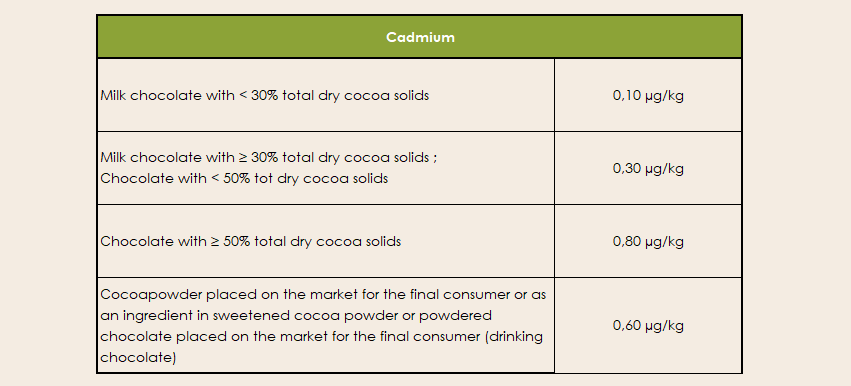
The presence of this heavy metal is linked to the naturally high cadmium levels found in volcanic soils. The cocoa plant absorbs cadmium through its roots, which means it accumulates in the nib (the edible part of the bean, after removing the shell). This is especially critical for products with high cocoa content — such as dark chocolate and cocoa powder — due to the strict maximum levels set by the European Union (EU).
Lead:
Lead contamination is primarily associated with African cocoa-producing regions, such as Ghana and Ivory Coast.
The risk often originates from drying practices along roadsides, or from contact with dust and contaminated equipment. Unlike cadmium, lead tends to remain on the husk (outer shell), which is removed during processing. Still, minimizing exposure throughout the value chain is important to prevent unwanted residues in the final product.
Mycotoxins (especially ochratoxin A)
Mycotoxins are toxic compounds produced by molds such as Aspergillus and Penicillium. The most relevant mycotoxin for cocoa is ochratoxin A, which can develop due to poor drying or storage conditions — particularly in environments with high humidity and insufficient ventilation.
- These risks are present in Africa, Latin America, and Asia, but they tend to increase in small-scale operations with less controlled post-harvest processes.
- Aflatoxin B1 is rarely found in cocoa and typically occurs only in damaged or poorly stored beans.
- Other mycotoxins like fumonisins, ZEA, or DON are more relevant to grains and are seldom an issue in cocoa.
Pesticides and organic certification
The presence of pesticide residues varies significantly depending on local agricultural practices and national regulations. Some regions, such as the Dominican Republic or specific parts of Africa, are known for applying stricter organic standards, which may reduce chemical contamination risks.
Legislation: what food producers should keep in mind
- Currently, there are no specific EU limits for lead content in cocoa products, but rigorous quality control remains crucial.
- The European Union has set strict cadmium limits for cocoa and chocolate products:
- For cocoa powder there is a maximum limit of 3.0 µg/kg for ochratoxin A.
Conclusion: origin matters
Choosing cocoa from Africa, Latin America or Asia has a direct impact on the flavor, quality and food safety of your final product. By understanding the growing conditions and local practices, food processors can make more informed sourcing decisions — whether aiming for bulk production or crafting premium chocolates with unique flavor profiles.