

News
France introduces temporary ban on certain imported foods
Why this matters?
This national measure does not change EU MRL legislation, but it does affect market access to France and increases expectations for operator due diligence.
Background
January 5, 2026, the French authorities adopted a national order (arrêté) introducing a temporary ban on the import, introduction and placing on the French market of certain foodstuffs originating from third countries.
The measure targets foods that contain quantifiable residues of specific plant protection products (PPPs) which are no longer approved for use in the EU, even in cases where EU Maximum Residue Levels (MRLs) are still set.
This national initiative reflects increased regulatory attention on residue compliance at EU borders and places additional responsibilities on food and feed business operators supplying the French market.
What has been decided?
Under the French order, foodstuffs may not be placed on the French market if they contain detectable (quantifiable) residues of certain EU-banned active substances.
The measure applies to:
- Imports from non-EU countries
- Raw and processed foodstuffs
- Food and feed products
A limited transitional (sell-through) period of one month is foreseen under the conditions set out in the order.
The measure is temporary and will remain in force:
- until EU-level measures are adopted, or
for a maximum duration of one year
Which substances are concerned?
The order specifically targets the following active substances:
- Carbendazim / Benomyl
- Thiophanate-methyl
- Mancozeb
- Glufosinate
These substances are no longer approved for use in the EU, mainly due to concerns related to human health and environmental safety.
Which products are affected?
The French authorities have defined a specific list of commodities to which the measure applies.
These include, among others:
- Fruit & vegetables:
citrus fruit, apples, pears, grapes, mangoes, papayas, avocados, tomatoes, aubergines, okra, lettuce, potatoes - Cereals, oilseeds & pulses:
soybeans, wheat, barley, oats and rye
The exact commodity–substance combinations are laid down in the annex to the French order, which remains the legally binding reference.
Practical overview
To support quality and regulatory teams, we provide below a practical overview of the commodity–substance combinations targeted by the French measure.
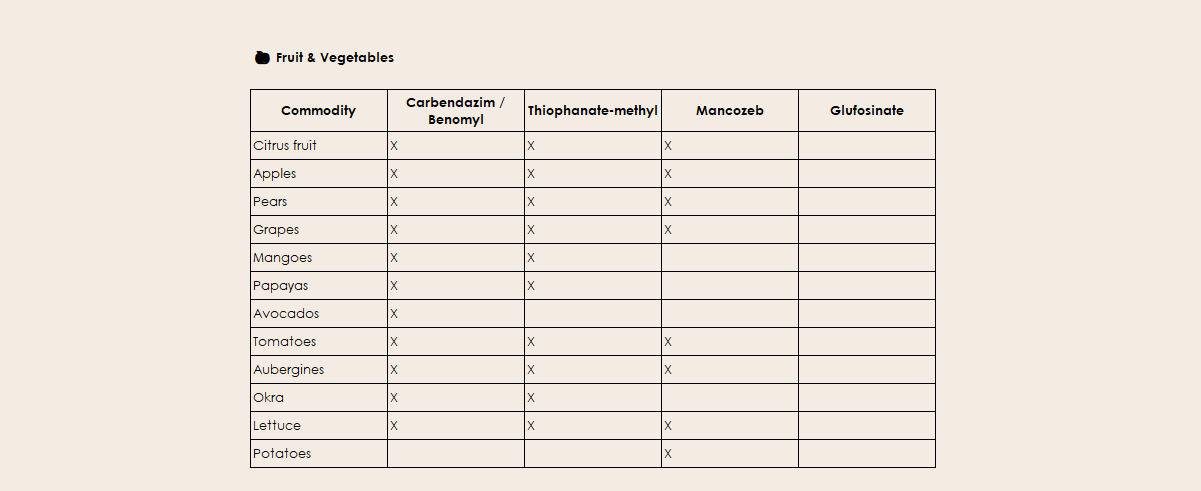
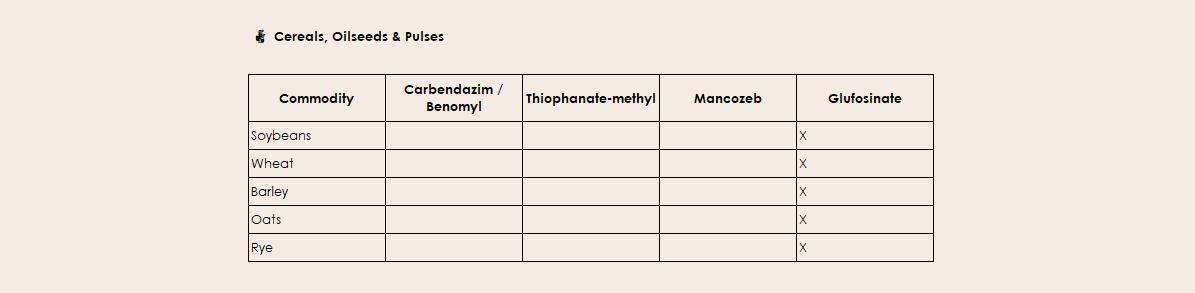
This overview supports risk-based decision making for sourcing, sampling and supplier management.
The legally binding reference remains the official French order and its annex.
What does this mean for QA and regulatory teams?
French authorities expect operators to be able to actively demonstrate compliance.
In practice, this means that QA and regulatory teams may need to:
- review supplier approval and specifications,
- verify that targeted substances are not used in primary production,
- ensure the availability of supporting documentation (e.g. declarations, production information),
- perform analytical testing, where relevant, as part of a risk-based control strategy.
Even for operators not primarily focused on the French market, this measure is relevant where France forms part of the distribution chain.
This article is provided for information purposes only and does not replace the official legal text.
Operators remain responsible for compliance with applicable legislation.