
News
PAHs in cocoa: a risk in chocolate production
Cocoa is loved worldwide for its rich flavour and versatility — but behind that smooth chocolate bar lies a complex production process with some lesser-known food safety risks. One of those risks is PAHs, or polycyclic aromatic hydrocarbons — a group of chemical compounds that can form during the processing of cocoa beans.
PAHs can have serious consequences for public health, regulatory compliance and ultimately, market access.
Where do PAHs come from?
PAHs are not added to cocoa — they form unintentionally during production. Specifically, they arise when organic matter is exposed to high heat or incomplete combustion, such as:
- Roasting cocoa beans at high temperatures, especially above 200°C
- Drying beans over open wood fires or in smoky environments
- Using contaminated fuels or outdated equipment during processing
The risk? Certain PAHs, like benzo[a]pyrene, have been classified as probable human carcinogens. Long-term exposure is linked to liver damage, reproductive issues, and developmental harm, especially in vulnerable groups like children and pregnant women.
Regulatory pressure is increasing
In response to these risks, the European Union has implemented strict maximum levels for PAHs in cocoa products. The current limits (per EU Regulation 2023/915) focus on the sum of four key PAHs, including benzo[a]pyrene, benzo(b)fluoranthene, benzo[a]anthracene, and chrysene:
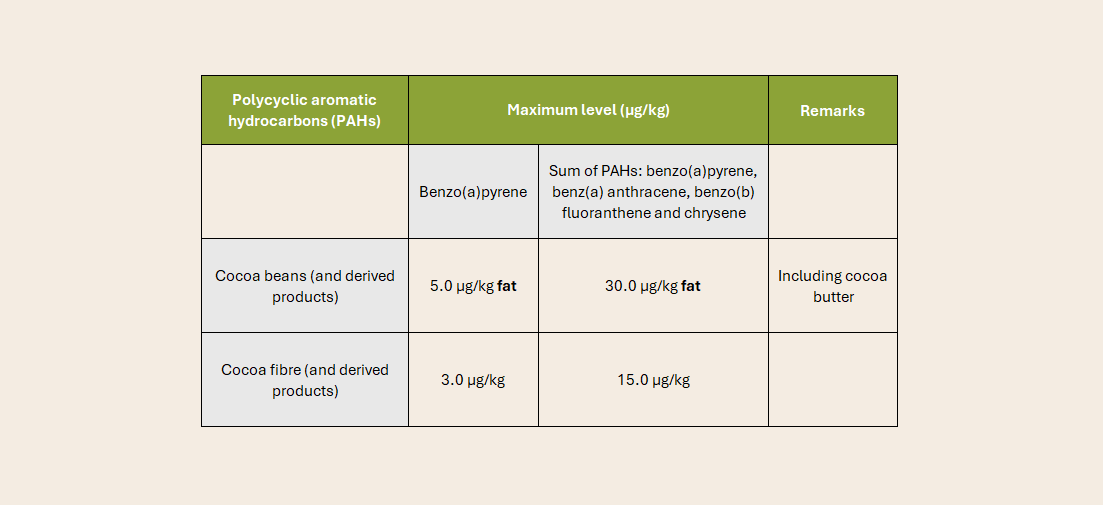
Cocoa fibre is a specific cocoa product produced from the shell of the cocoa bean and contains higher levels of PAHs than the cocoa products produced from the cocoa nibs. The cocoa fibre and derived products are intermediate products in the production chain and are used as an ingredient in the preparation of low calorie, high fibre food.
Because PAHs accumulate in fat, legal limits are expressed per kilogram of fat — not total product weight.
How to reduce PAH risks
The good news: with the right approach, PAH levels can be significantly reduced. A few best practices include:
- Optimizing roasting conditions: Use lower temperatures and shorter roasting times where possible.
- Switching to clean energy: Avoid wood fires or smoke-based drying; electric or gas drying is cleaner and more consistent.
- Regular laboratory testing: Monitoring PAH levels in both raw materials and final products ensures early detection and compliance.
- Modernizing drying methods: Mechanical dryers reduce the risk of smoke contamination.
Conclusion: A small compound with big consequences
For food manufacturers and cocoa processors, PAHs are a classic example of a silent threat — one that doesn’t affect taste or appearance, but can still lead to regulatory non-compliance, import issues, or brand damage.
At Primoris, we support cocoa businesses across the value chain with accredited testing for PAHs and tailored advice on mitigation strategies.