
News
Why a reliable analytical result starts with a representative sample
Why a reliable analytical result starts with a representative sample
When two analyses from the same lot produce very different results, it is easy to look first at the laboratory. Was a different analytical method used? Was there an issue during the analysis? Does measurement uncertainty explain the difference?
But sometimes, the most important difference occurred before the analysis even started.
A laboratory result relates to the material that was actually analysed. For that result to say something meaningful about an entire lot, representativeness needs to be considered throughout the process — from sampling the lot to preparing the sample in the laboratory.
It starts with sampling
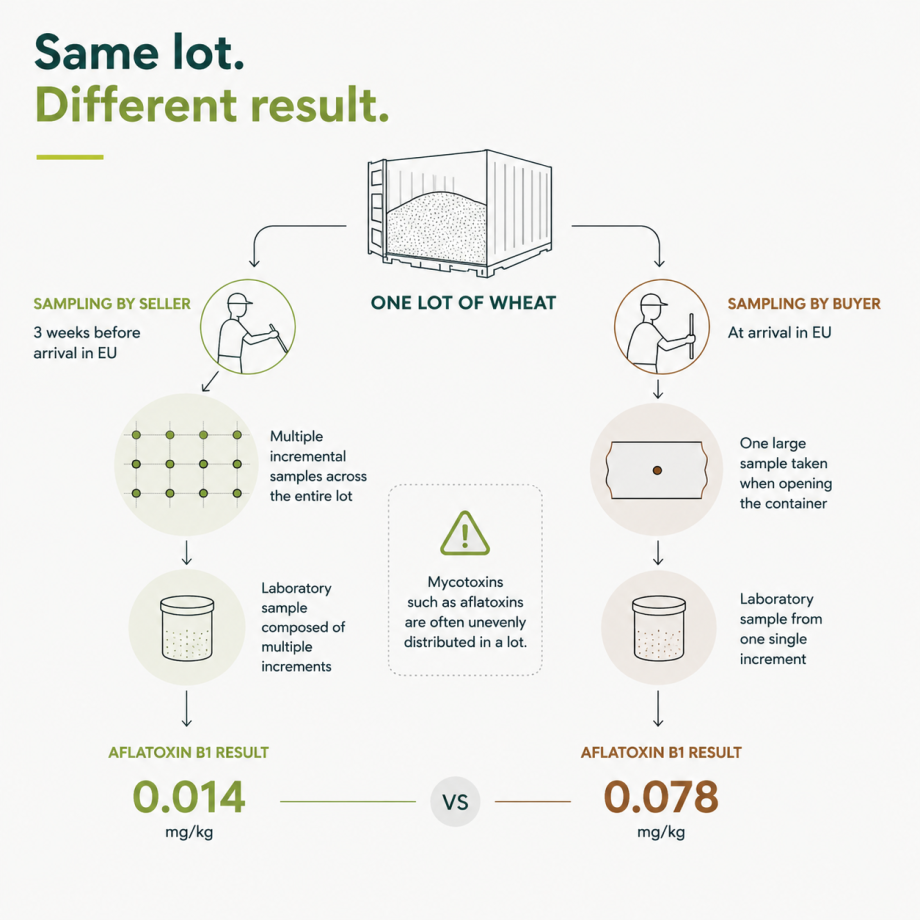
Imagine a lot of wheat that is tested for aflatoxin B1.
An analysis performed for the seller gives a result of 0.014 mg/kg. A later analysis performed for the buyer gives 0.078 mg/kg.
Same lot, very different result.
In this case, however, the samples were collected differently.
For the seller's analysis, multiple incremental samples were collected throughout the lot by a certified sampler and combined into a laboratory sample.
For the buyer's analysis, one large sample was taken when the container was opened.
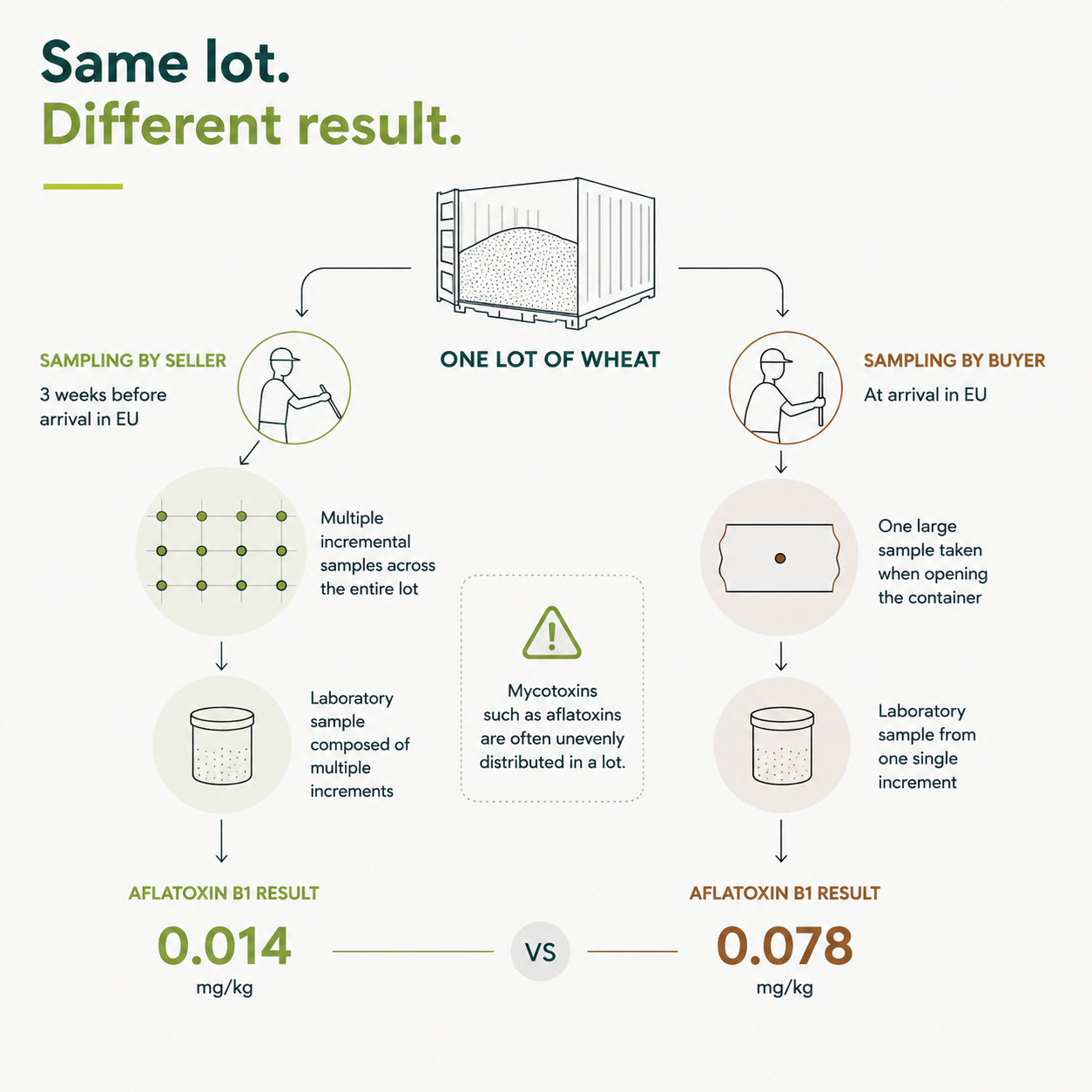
Although both samples originated from the same lot, they did not necessarily represent that lot in the same way. This means that simply comparing the two analytical results does not tell the whole story.
Why does this matter particularly for mycotoxins?
Not every contaminant is distributed evenly throughout a lot.
Mycotoxins can occur very heterogeneously, with much higher concentrations in certain parts of a batch than in others. This makes the location and number of increments taken during sampling especially important.
A large sample taken from one location is therefore not automatically more representative than a sample composed of multiple increments collected throughout the lot.
This is also why sampling protocols generally define both the number of incremental samples to be collected and the amount of material that should make up the aggregate or laboratory sample. The applicable approach depends, among other things, on the size of the lot and the product type. But representative sampling is only the beginning.
What happens when the sample reaches the laboratory?
The laboratory may receive hundreds of grams or even several kilograms of material. Only a small fraction of that material will eventually be used for the analytical determination.
The challenge is therefore to reduce the sample without losing its representativeness along the way.
Sample preparation plays an essential role here.
Depending on the product, the laboratory sample may first need to be reduced appropriately before it is homogenised. In many cases, the material is finely ground to obtain a homogeneous sample. A smaller representative portion can then be taken for extraction and subsequent analysis.
In simplified form:
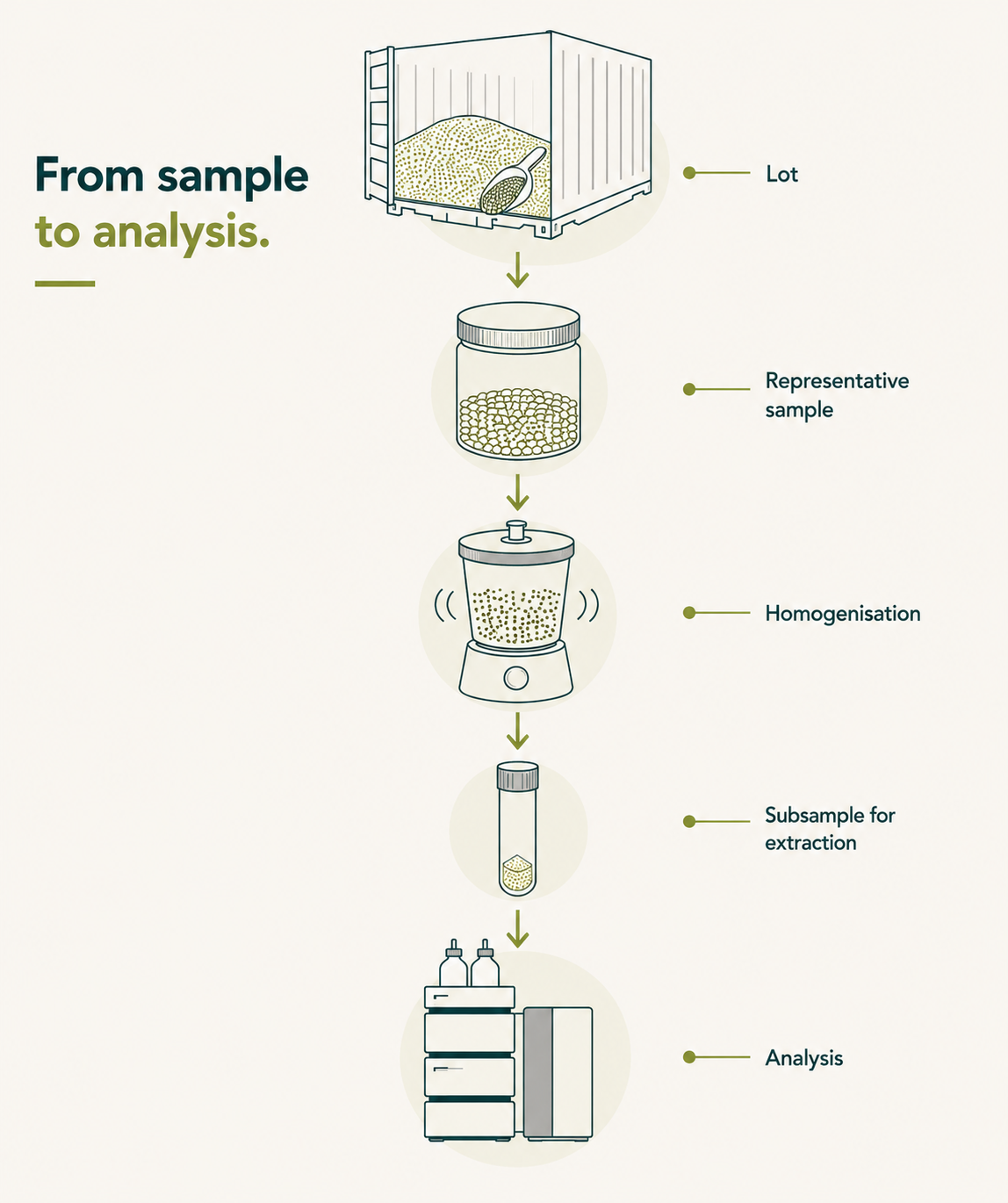
At every reduction step, the objective remains the same: the small portion that eventually reaches the analytical method should represent the material it came from as well as possible.
Bigger does not automatically mean more representative
This also explains why the question “How much sample should I send?” does not always have one simple answer. A larger sample can be valuable, particularly for heterogeneous contamination. But sample weight alone does not determine representativeness.
How the sample was collected matters just as much as how much material was collected.
And once a large sample reaches the laboratory, it also needs to be processed appropriately. During the training, this practical question came up explicitly: larger samples can improve representativeness, but there are practical limits and the appropriate quantity depends on the sampling requirements and the material being analysed.
So a 5 kg sample collected from one spot should not automatically be considered "better" than a smaller laboratory sample composed of properly distributed increments.
When two results differ, look beyond the numbers
When analytical results from the same lot differ considerably, comparing the numbers alone may therefore lead to the wrong conclusion.
Before looking only at the analytical method, it is worth asking:
- How was each sample collected?
- Were multiple increments taken throughout the lot?
- Were both laboratory samples representative of the same material?
- How were the samples prepared before analysis?
A laboratory can perform an analytical determination with great precision. But that result ultimately describes the material that reached the analytical process.
Reliable analysis therefore starts with a representative sample and with preserving that representativeness all the way to analysis.